Two Liquids, a Few Seconds, One Roof: The Chemistry Behind Closed-Cell Spray Foam
Every spray foam roof in South Florida starts the same way: two drums of liquid on a truck. One is called the A-side, the other the B-side. Neither one is a roof. But push them through a heated hose at high pressure, mix them at the gun for a fraction of a second, and they hit your deck as a liquid that becomes a rigid, closed-cell solid before you can finish a sentence.
If you manage commercial property in Broward, Miami-Dade, or Palm Beach, you've probably heard spray polyurethane foam (SPF) described as "seamless" or "monolithic" and filed it under marketing. It isn't. It's chemistry — and understanding what actually happens in that reaction explains why SPF roofs behave so differently from every membrane roof around them, especially in hurricane country. After 30+ years and more than 10 million square feet of foam installed across South Florida, we've watched this chemistry outperform sheet goods in the exact conditions that destroy them. Here's what's going on at the molecular level.
The A-Side, the B-Side, and What Happens at the Gun
The A-side is polymeric MDI — a diisocyanate, the reactive workhorse of polyurethane chemistry. The B-side is a proprietary blend of polyols mixed with catalysts, surfactants, flame retardants, and blowing agents. Kept apart, both are stable liquids. Combined in a 1:1 ratio at the spray gun, the isocyanate and polyol molecules link into long polyurethane chains, and the reaction throws off heat.
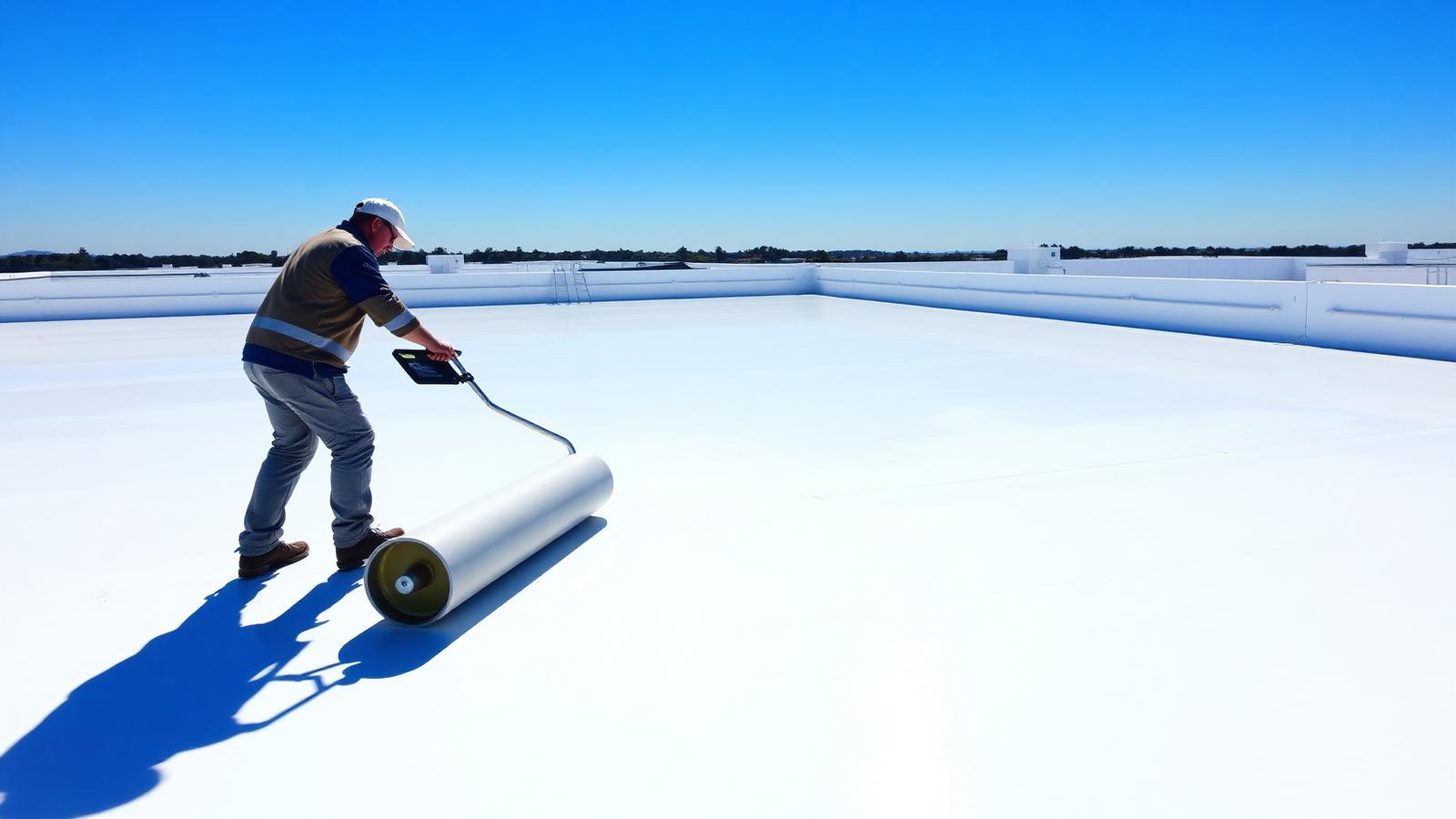
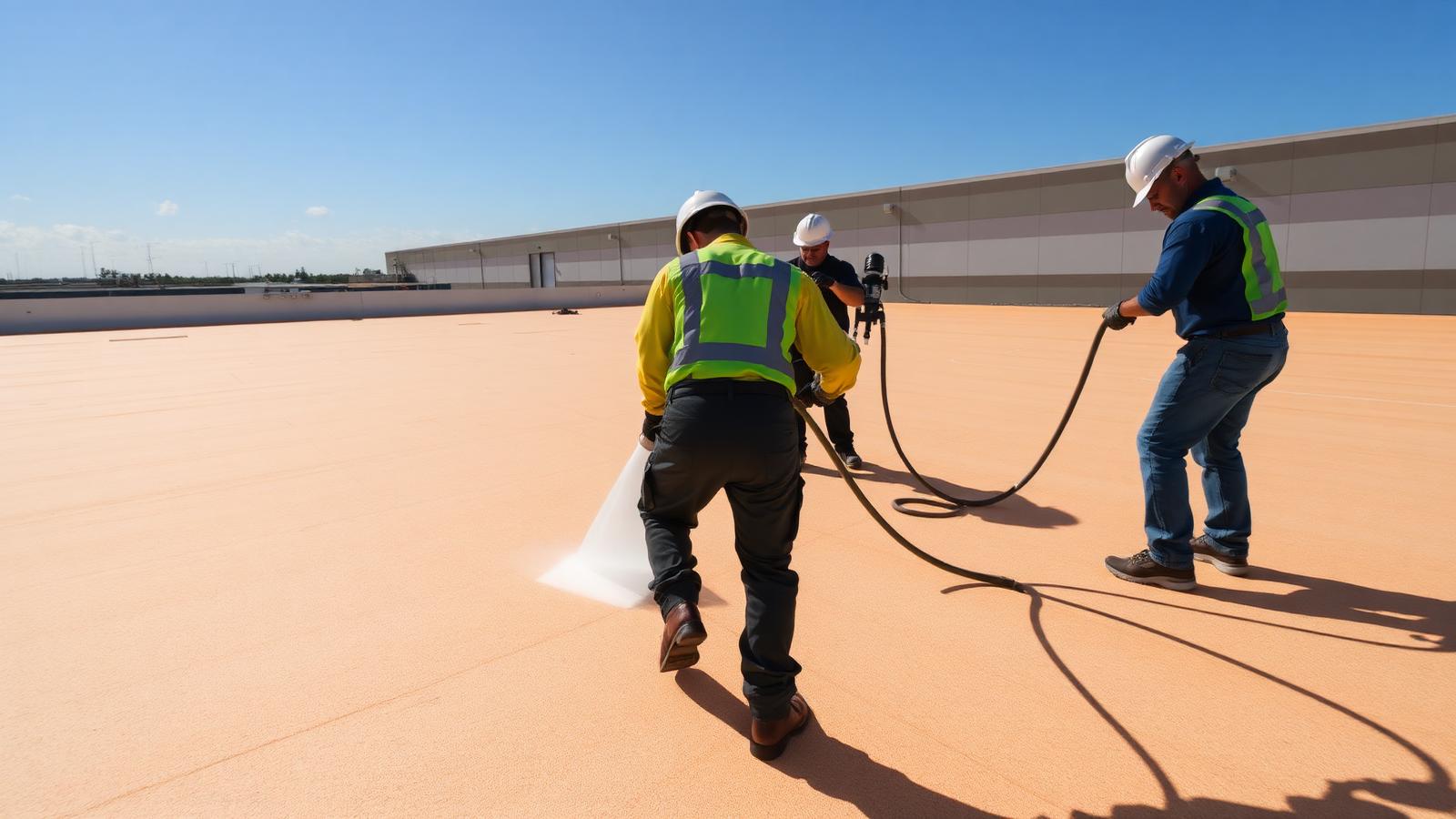
That heat is the trick. It vaporizes the blowing agent, which inflates the curing plastic into billions of tiny bubbles — the foam rises to many times its liquid volume in seconds and locks rigid. On a commercial roof, an experienced applicator is essentially manufacturing the roofing material in place, in one continuous pass, shaped to every curb, drain, penetration, and parapet on your deck. There is no seam because there was never a sheet. The foam is one connected solid from edge to edge.
This is also why applicator skill matters more in SPF than in almost any other roofing system. Temperature, humidity, wind, mix ratio, pass thickness — all of it affects the reaction. It's a big part of why our core crew has been spraying together for 20+ years, and why other roofing contractors sub their foam work to us rather than buying a rig and learning on someone's roof.
Why "Closed-Cell" Is the Whole Ballgame
Those billions of bubbles come in two varieties. Open-cell foam — the soft stuff used inside walls — has broken bubble walls that let air and water move through. Roofing foam is closed-cell: each bubble is a sealed, intact sphere of rigid polyurethane with gas trapped inside.
That structure does three jobs at once:
It stops water. Sealed cells mean there's no path for water to travel. In standardized water-penetration testing (ASTM E331 and E2357), closed-cell SPF assemblies have shown no leakage through the foam itself. Rain sitting on closed-cell foam is sitting on billions of sealed compartments, not soaking into a sponge.
It insulates better than anything else you can put on a roof. The trapped blowing-agent gas conducts heat poorly, giving SPF roughly R-5.5 to R-6.5 per inch — the highest R-value per inch of any common roofing insulation. On a South Florida roof that bakes over 300 days a year, that's a direct, permanent cut in the heat load your air conditioning fights every afternoon.
It carries load. Roofing-grade SPF is dense — typically 2.5 to 4 pounds per cubic foot, versus about half a pound for wall foam — and that density buys compressive strength of 40 psi or more, often 40 to 55 psi. That's over 5,700 pounds of resistance per square foot. Foot traffic, HVAC techs, dropped tools: the roof shrugs them off.
The Adhesion Advantage: Why Hurricanes Can't Get a Grip
Hurricane wind doesn't push roofs down; it pulls them up. Wind accelerating over your roof edge creates negative pressure — suction — and the roof's job is to hold on. Mechanically fastened membranes hold on at screw points. Glued membranes hold on where the adhesive was rolled. SPF holds on everywhere, because it chemically bonded to the substrate while it was still liquid.
The numbers are hard to argue with. In FM 4474 wind-uplift testing, SPF applied to structural decks routinely doesn't fail until around 900 pounds per square foot of pull — and when it does, the failure is in the substrate, not the foam bond. SPF systems can meet Florida's High Velocity Hurricane Zone criteria, the toughest wind standard in the country.
The real-world data backs the lab. After Hurricane Katrina, the National Institute of Standards and Technology examined roofs across the damage zone and reported that SPF roofs "performed well without blow-off of the SPF or damage to flashings," keeping buildings dry while surrounding membrane roofs peeled.
A hurricane can't peel off a roof that has no edge to grab and no seam to open.
The Silicone Skin — and the Roof That Renews Itself
Polyurethane foam has one enemy: sunlight. UV slowly chalks and erodes unprotected foam, so every SPF roof gets a protective elastomeric topcoat — on our roofs, typically silicone, which shrugs off UV and ponding water and can stretch to roughly twice its length before breaking, so it moves with the roof through thermal cycling instead of cracking.
Here's the part that changes your budget math: the coating is the sacrificial layer. The foam underneath doesn't wear out; the coating does, slowly, over 10 to 20 years. When it thins, you clean the roof and recoat it — no tear-off, no dumpsters, no tenants relocated. Maintained this way, SPF roofs routinely last 30 years and more, effectively renewing indefinitely. That's the science behind our restore-don't-replace position: a restoration typically runs about a third the cost of replacement.
One honest caveat, because chemistry cuts both ways: foam bonds to what's under it, so a wet substrate is a dealbreaker. That's our Moisture Rule — under 15% saturation on a moisture survey, your roof is a restoration candidate; over 50%, we'll tell you to replace it, even though that's not the job we sell.
FAQ
How thick is a spray foam roof? Most commercial applications run 1 to 2 inches minimum, built up in passes. Because the foam is self-leveling by hand, we can also add thickness strategically to build slope toward drains and eliminate ponding areas.
Does SPF work over my existing roof? Usually, yes — SPF adheres to concrete, metal, wood, BUR, and modified bitumen after proper cleaning and priming, which is what makes no-tear-off restoration possible. The deciding factor is moisture in the existing assembly, which is why every project starts with an assessment.
Is the smell or overspray a problem for my tenants? The reaction is fast and the cured foam is inert. We schedule spraying around wind conditions, mask adjacent surfaces and intakes, and keep buildings occupied throughout — with 7 fully-rigged trucks, we've done it on 10M+ square feet of occupied commercial property.
Get the Chemistry Working for Your Building
The best way to find out whether closed-cell SPF fits your roof is to measure, not guess. ROOF KING has been spraying foam across South Florida for over 30 years from our Pompano Beach headquarters — same core crew for 20+ of them. We'll inspect your roof, run the moisture numbers, and give you a straight answer: restore, repair, or replace. Schedule your free roof assessment today at 954-782-3002.
Sources
Related reading
Free assessment
Free Commercial Roof Assessment
Licensed & insured Florida commercial roofing. Spray foam and silicone restoration across South Florida — no pressure, no cost.