Hurricanes Don't Blow Roofs Off — They Pull Them Off. Here's the Physics That Decides Whether Yours Stays.
Every South Florida property manager has seen the aftermath photo: a commercial roof peeled back like a sardine can, insulation scattered across the parking lot. Here's what most people get wrong about that photo. The wind didn't push that roof off. It pulled it off — from above, by suction — and it almost certainly started at a seam, a fastener row, or an edge. Understand that one fact and you understand why some roofing systems keep failing in Broward and Miami-Dade, and why a fully-adhered spray polyurethane foam (SPF) roof behaves so differently when the wind starts working.
After 30+ years and 10M+ square feet installed across South Florida, we've seen what wind does to every kind of commercial roof. This is the science underneath it.
Wind Uplift 101: Your Roof Is an Airplane Wing
When hurricane-force wind hits your building, it doesn't stop — it accelerates up the wall and across the roof surface. Fast-moving air over a surface creates a zone of low pressure above it. That's the same principle that generates lift on an airplane wing, and on a flat commercial roof it means the atmosphere inside and below the building is now pushing up harder than the air above is pushing down.
The result is net suction — engineers call it negative pressure, measured in pounds per square foot (psf). It's strongest where the airflow separates and swirls: the corners and perimeter edges of the roof. Corner zones on a flat roof routinely see suction pressures two to three times higher than the middle of the roof field. One worked example for a South Florida building at a 175 mph design wind speed puts corner suction at roughly 100 psf — about 100 pounds of pull on every single square foot, cycling and hammering for hours.
That's why wind failures almost never start in the middle of the roof. They start at a corner or an edge, where the suction is highest — and then they propagate.
How Conventional Roofs Lose This Fight
A mechanically attached single-ply membrane (TPO, PVC, EPDM) is held down at discrete points: rows of fasteners and plates, with the membrane fluttering between them under load. Every fastener is a stress concentration. Every seam is a potential starting notch. When a corner gusts past the assembly's rated pressure, one fastener backs out or one seam lip catches wind — and now the storm has a handle. Peeling a membrane that has a loose edge takes a fraction of the force that uniform uplift would require. The failure unzips row by row.
Ballasted and gravel-surfaced roofs have their own problem: the wind scours the ballast off the corners first, then goes to work on what's underneath — while the gravel becomes airborne debris for the building next door.
This is why the Florida Building Code treats our corner of the state differently. Miami-Dade and Broward counties sit entirely inside the High Velocity Hurricane Zone (HVHZ), with ASCE 7-22 design wind speeds in the range of 170–180 mph for standard commercial buildings. HVHZ roof assemblies must survive brutal product-approval testing — including cyclic pressure protocols that load the assembly thousands of times to simulate hours of gust cycling. The code's message is blunt: in South Florida, average attachment isn't attachment.
Why SPF Changes the Physics
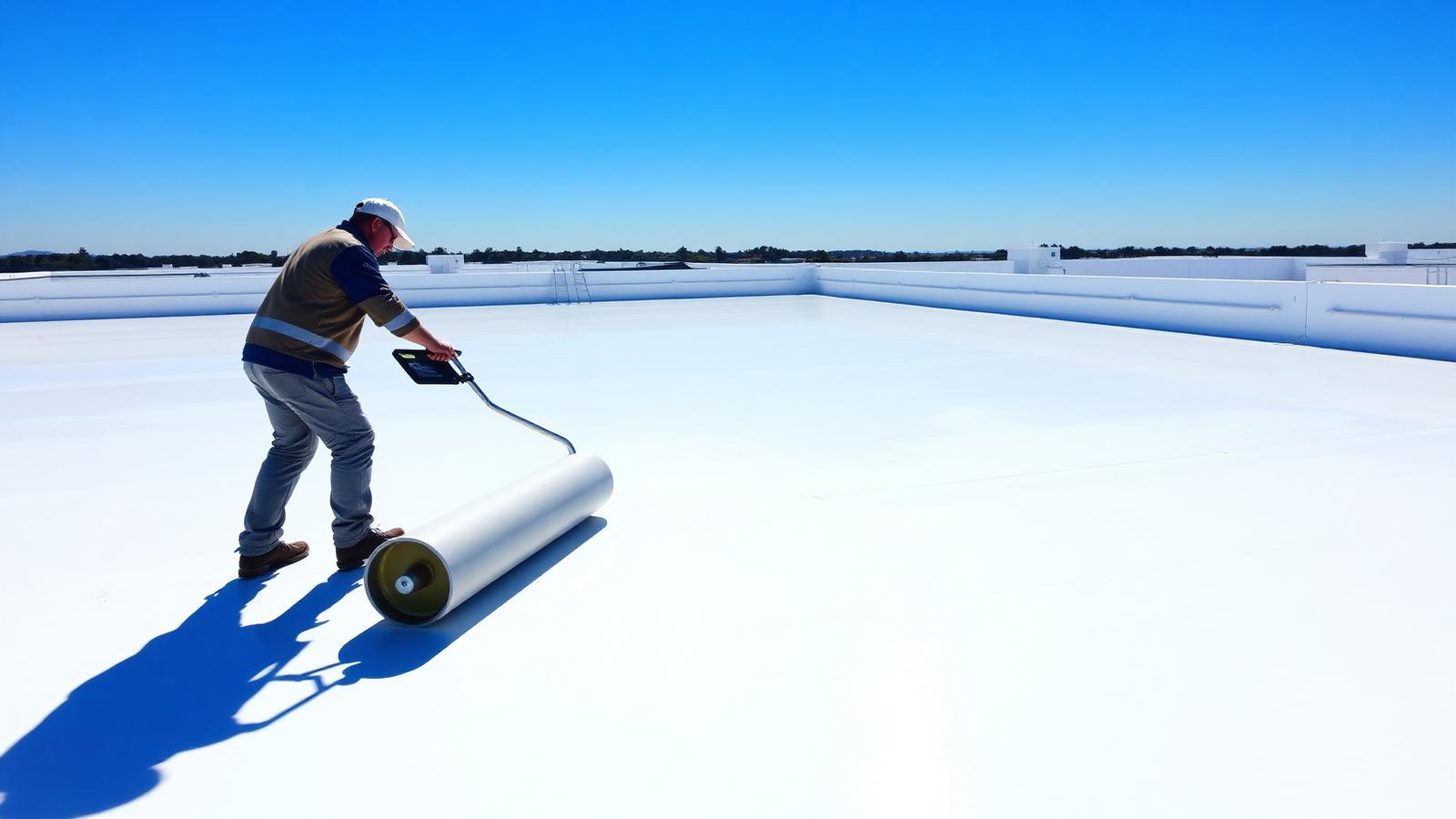
A spray polyurethane foam roof isn't fastened to your building at discrete points. It's chemically and physically bonded to it — continuously, across every square inch.
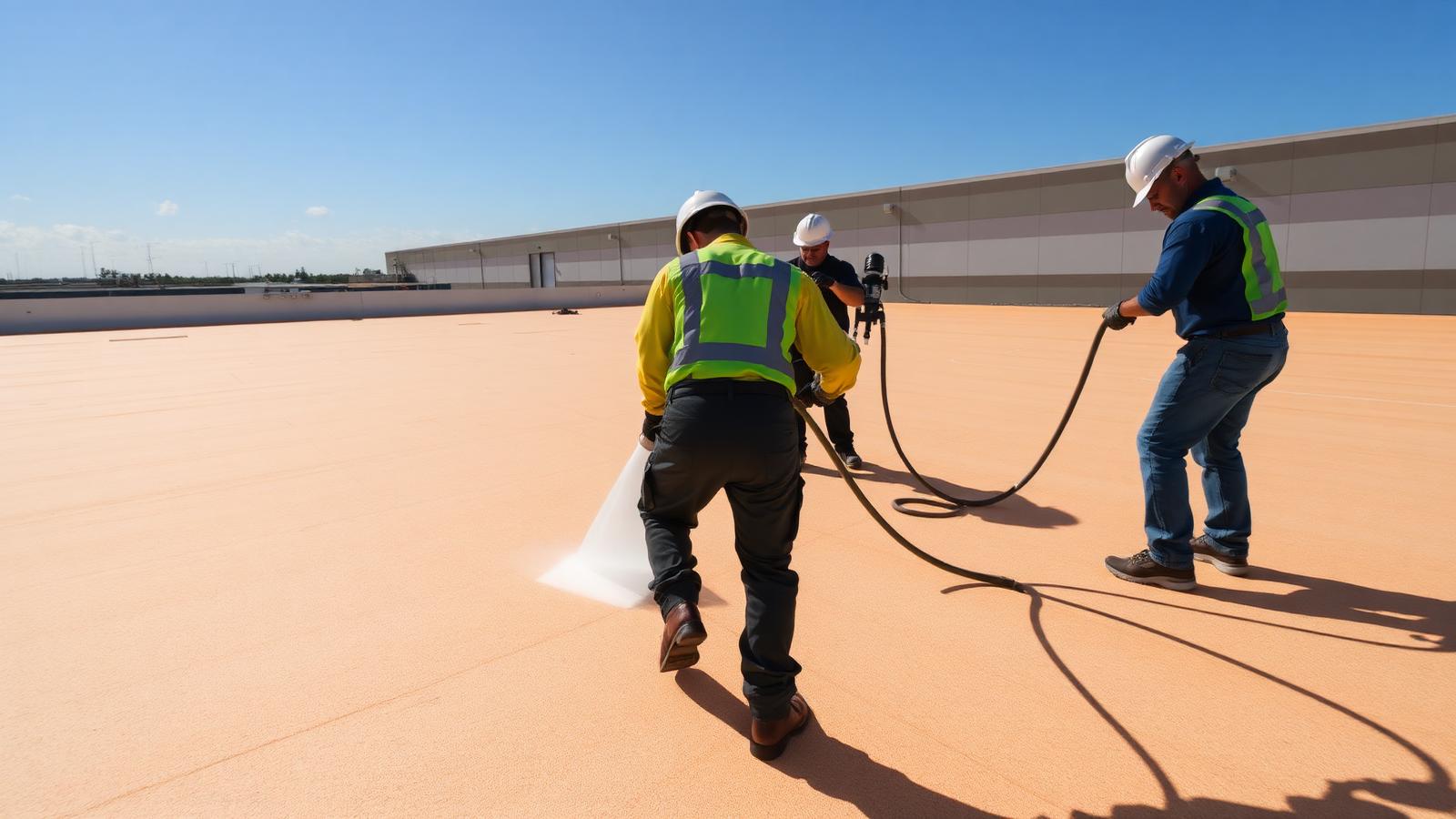
Two liquid components mix at the spray gun, react, and expand into rigid closed-cell foam that adheres directly to the substrate as it cures. There are no fasteners to back out. There are no seams to catch wind — the finished surface is one monolithic piece, self-flashed around every curb, drain, and penetration. There is no loose edge for the storm to grab, because the "membrane" and the attachment are the same material.
The numbers behind that are remarkable. Industry wind testing under FM 4474 of SPF applied directly to structural concrete decks has produced tensile adhesive failures at roughly 900 psf — several times beyond what even HVHZ corner-zone design pressures demand, and beyond what much standard test equipment can apply. The cured foam itself carries a compressive strength of roughly 40–55 psi at a density near 2.8 pounds per cubic foot, with a silicone topcoat protecting it from UV.
Hurricanes don't blow roofs off — they pull them off, one fastener and one seam at a time. A spray foam roof gives the wind nothing to grab.
This isn't theory. After Hurricanes Katrina and Rita, the National Institute of Standards and Technology (NIST) sent reconnaissance teams to study how real buildings performed. Their report found that buildings roofed with spray foam "performed well without blow-off of the SPF or damage to flashings" — the SPF roofs stayed intact, kept water out, and shielded the structures from hail and debris. In storms that destroyed conventional roofs by the thousands, examined SPF roofs came through with only one showing notable damage.
The Honest Fine Print: Adhesion Is a Chain
Here's what a sales brochure won't tell you, and what 30+ years in this trade will: an SPF roof is only as wind-resistant as what it's stuck to.
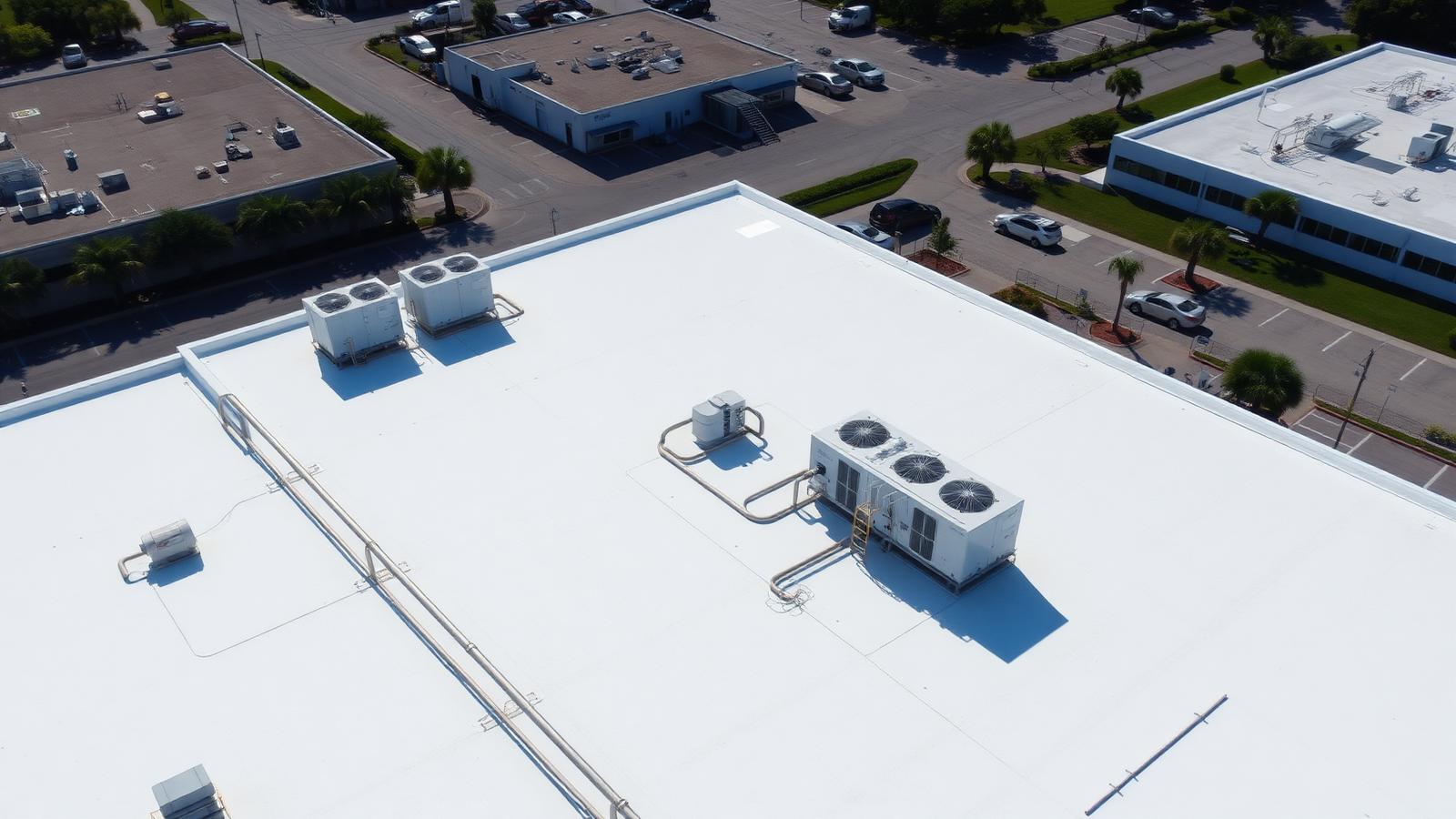
When SPF is installed over an existing roof (a recover — the "restore, don't replace" scenario that saves our clients about two-thirds versus tear-off), the uplift chain runs foam → existing roof → deck → structure. If the existing membrane is poorly attached, or if the deck itself is wet and deteriorating, world-class foam adhesion upstream doesn't fix a weak link downstream. That's exactly why we run moisture scans and adhesion evaluations before we quote anything, and why we follow the Moisture Rule: under 15% of the roof wet, restoration is smart; over 50% wet, we'll tell you to replace, because foam over a failing substrate is money wasted. The same crew has been making those calls for us for 20+ years, and honest disqualification is how they've kept clients that long.
Post-storm care matters too. High winds can scuff coatings at corners and around rooftop equipment — minor, cheap to touch up, but only if someone looks. That's the job of a maintenance program like our Crown Care plan: inspect after wind events, repair small, never repair big.
FAQ
Can an SPF roof really handle HVHZ wind requirements in Miami-Dade and Broward? Yes — SPF systems can be designed for any wind zone, and specific assemblies carry the product approvals HVHZ jurisdictions require. The critical variable is substrate condition and preparation, which is why the pre-job inspection matters as much as the foam.
My existing flat roof is mechanically attached. Does spraying foam over it fix the wind problem? Partially. The foam eliminates seams and edge-peel vulnerability and adds stiffness, but total uplift resistance still depends on how well the existing roof is secured to the deck. A proper evaluation — including fastener and adhesion checks — tells you whether a recover meets your building's design pressures.
What should I check on my roof after a major wind event? Corners, perimeter edges, and the areas around HVAC units and other equipment — the high-suction zones. Look for scuffed or exposed foam, lifted flashings on adjacent construction, and debris impact points. Better yet, have it inspected professionally; small coating repairs cost little, while ignored ones let UV and water start working.
Wind season doesn't negotiate, and neither does physics. If you manage a commercial building in Broward, Miami-Dade, or Palm Beach County and you don't know your roof's uplift story — how it's attached, where it's vulnerable, what shape the corners are in — find out before the atmosphere tests it for you. ROOF KING has spent 30+ years and 10M+ square feet building roofs the wind can't grab. Schedule your free roof assessment today: 954-782-3002. Strength from above.
Sources
Related reading
Free assessment
Free Commercial Roof Assessment
Licensed & insured Florida commercial roofing. Spray foam and silicone restoration across South Florida — no pressure, no cost.