FPL's Biggest Rate Hike in History Is Now on Your Bill. Your Roof Can Claw Some of It Back.
If you manage a commercial building in Broward, Miami-Dade, or Palm Beach County, you've already seen it: the first step of FPL's record rate increase landed on your January 2026 bill, and the next step is scheduled for January 2027. The settlement Florida regulators approved in November 2025 adds $945 million in base rates for 2026, another $705 million in 2027, and additional collections in 2028 and 2029 for solar and battery projects — roughly $6.9 billion over four years by opponents' math. Consumer advocates are fighting it at the Florida Supreme Court, but as of today, those rates are in effect.
You can't negotiate with the utility. What you can control is how much of that more-expensive electricity your building burns fighting the sun. And in South Florida, a surprising share of that fight happens on your roof.
What Actually Got Approved — and What It Means for a Commercial Meter
The numbers worth knowing:
- 2026: $945 million in new base rates, already in effect
- 2027: another $705 million step-up
- 2028–2029: additional charges tied to solar and battery buildouts
- Florida commercial customers were already paying around 12–13 cents per kWh on average heading into this year, per federal EIA data
Base-rate increases hit commercial accounts through both energy charges and demand charges — and demand charges are where hot roofs do their quiet damage. Your demand charge is set by your worst 15–30 minutes of the month, which in South Florida is almost always a sun-hammered summer afternoon when every rooftop unit is running flat out. A roof that loads up your HVAC at 3 p.m. in August isn't just costing you kilowatt-hours; it's setting the peak that prices your whole month.
Your Roof Is an Appliance. Most People Run It Backwards.
A dark, aged commercial roof — weathered mod-bit, dirty gravel BUR, old blackened membrane — reflects only about 10–20% of the sunlight that hits it. The rest becomes heat. Conventional roof surfaces routinely run 50–90°F hotter than the surrounding air, which means a 92°F Pompano Beach afternoon can put your roof deck at 150°F or more. That heat drives straight down into your conditioned space, and your chillers and RTUs pay to pump it back out.
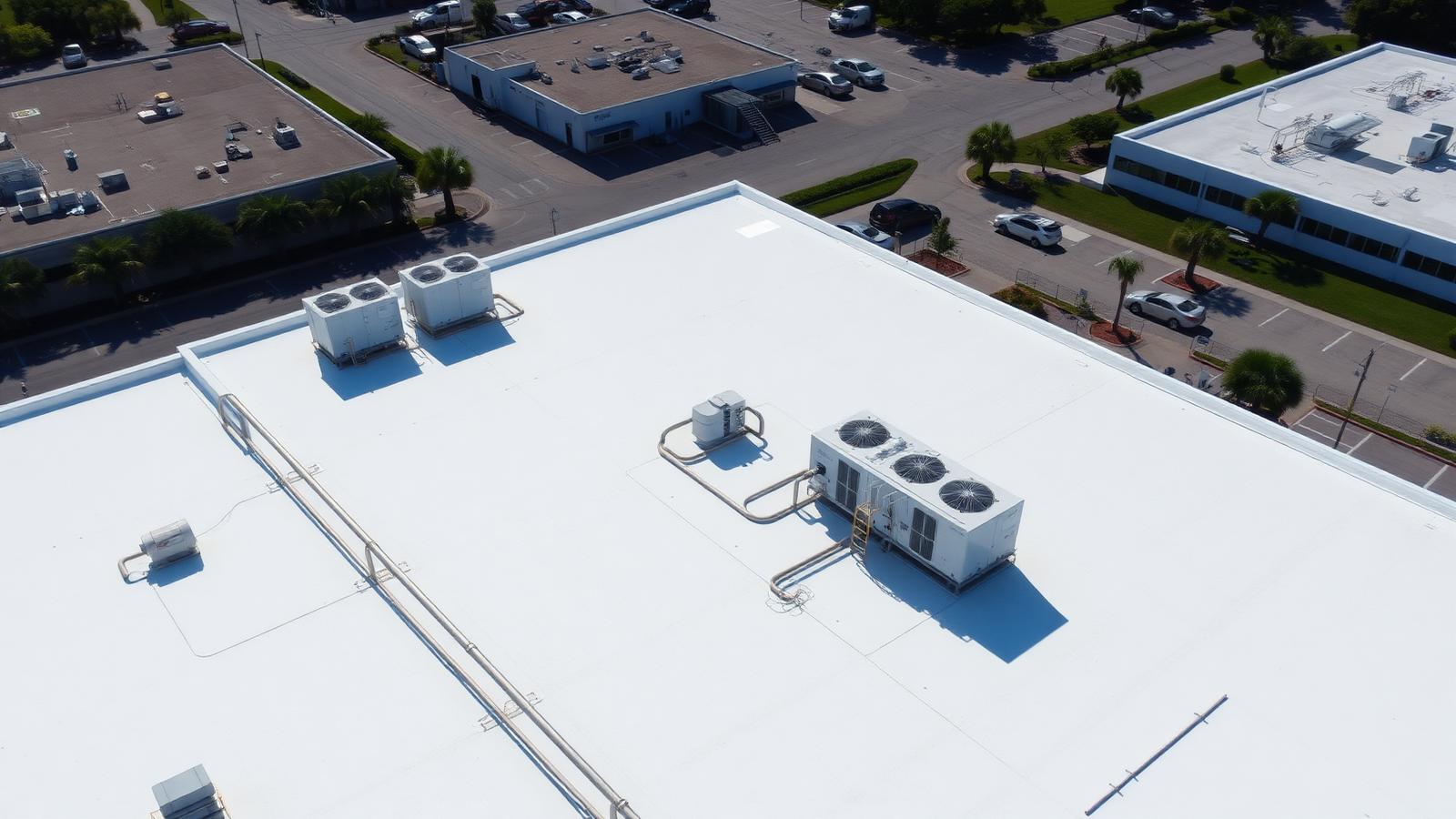
A high-reflectance white surface flips the equation. A cool roof stays only about 10°F above ambient air temperature, and even after years of South Florida weathering, a white roof still reflects roughly 60% of solar energy — three to six times more than the dark surface it replaced. The U.S. EPA and Department of Energy both point to cooling-energy reductions of up to 15% on single-story commercial buildings from cool roofing, with the biggest gains on exactly the building type South Florida has miles of: big, flat, single-story warehouses, retail, and light industrial under a huge roof-to-floor ratio.
This is precisely what a silicone restoration system does. The silicone topcoat that seals and waterproofs your existing roof is also, by its nature, a bright white, high-reflectance cool roof surface. The energy savings aren't an upgrade you buy — they're a side effect of the restoration you were already considering.
Every January through 2029, FPL rates step up — and every one of those steps quietly gives a white roof a raise.
The Math for a Real South Florida Building
Run it on a hypothetical but typical building: a 40,000-square-foot single-story flat-roof commercial property in Fort Lauderdale spending $100,000 a year on electricity. In South Florida, cooling commonly accounts for around 40–50% of a commercial building's electric use — call it $45,000 of that bill.
Apply a conservative 10% cooling reduction from converting a dark, aged roof to a reflective silicone surface, and you're holding onto roughly $4,500 a year at today's rates. Take the DOE's upper figure of 15% and it's closer to $6,750. Now layer in the part you can't opt out of: rates step up again in 2027, 2028, and 2029. The same kilowatt-hours you avoid are worth more every year of the settlement. Over a 10–15 year coating life, energy savings alone can quietly return a five-figure to low-six-figure sum — before you count the reason you actually did the project, which is a watertight, warrantied roof at about one-third the cost of replacement.
Your building's real numbers depend on insulation, HVAC condition, occupancy, and how dark and degraded the existing roof is. That's why we'd rather measure than promise — a free assessment puts actual numbers on your actual roof.
Where This Fits the Restore-vs-Replace Decision
Rising electric rates don't change our honesty rule, and they shouldn't change yours. We still run the Moisture Rule on every roof: if a moisture scan shows less than 15% of the roof is wet, it's a restoration candidate; if more than half the assembly is saturated, coating over it would be malpractice, and we'll tell you to replace. No energy savings justify sealing water into a failed roof.
But for the majority of aging South Florida commercial roofs that fall on the healthy side of that line, the FPL settlement just made restoration's ROI stack taller. You avoid a tear-off. You avoid tenant disruption. You spend roughly a third of replacement cost. And the white surface you end up with pushes back against a rate schedule that's already locked in through 2029. After 30+ years and more than 10 million square feet of SPF and silicone installed across Florida — with the same core crew for over 20 years — we've watched energy savings turn from a footnote in the proposal into one of the first questions owners ask.
One caveat that belongs in every money conversation: potential tax treatment of a restoration (including Section 179 expensing) has its own rules, so confirm the tax and utility-savings specifics for your property with your CPA or energy advisor.
FAQ
Does a white silicone roof really stay cooler in humid South Florida, or is that a desert-climate claim? It works here — arguably better. Reflectance physics doesn't care about humidity; it cares about sunshine, and South Florida's cooling season runs essentially ten to twelve months. The longer your A/C runs, the more hours per year a reflective surface is saving you money.
Will the coating stay reflective, or does it turn gray and stop working? All white roofs lose some reflectance to weathering and dirt — that's why we quote aged performance, not day-one numbers. Even weathered, a white coating typically reflects around three times what a dark roof does, and periodic cleaning under a maintenance program like Crown Care keeps performance near the top of that range.
My roof is 18 years old. Can I still get the cool-roof benefit without replacing it? Usually, yes — that's the entire point of restoration. If a moisture scan shows the roof is fundamentally dry (under the 15% threshold), a silicone system restores waterproofing and adds the reflective surface in one project, no tear-off, tenants in place.
FPL's rate schedule is set through 2029. What your building pays against it is not. ROOF KING has spent 30+ years helping South Florida owners and property managers restore commercial roofs instead of replacing them — strength from above, at about a third of the cost. Schedule your free roof assessment, or try the Instant Roof Analyzer online, and let's put real numbers on what your roof could be saving you: 954-782-3002.
Sources
Related reading
Free assessment
Free Commercial Roof Assessment
Licensed & insured Florida commercial roofing. Spray foam and silicone restoration across South Florida — no pressure, no cost.