Deduct It This Year or Depreciate It Until 2065: The Tax Line Between Roof Restoration and Replacement
It's late September. If you manage a commercial property in Broward, Miami-Dade, or Palm Beach County, you're staring at two calendars right now: the 2027 operating budget you're building, and the roughly 100 days left in the 2026 tax year. Here's a fact that belongs in both conversations — the IRS treats a roof replacement and a roof restoration as two fundamentally different transactions, and the difference can move the real, after-tax cost of your roof decision by six figures.
One quick disclaimer before the numbers: we're roofers, not accountants. Everything below is general information to bring to your CPA — the repair-versus-capitalization rules are fact-specific, and your tax professional makes the final call.
A New Roof Is a 39-Year Asset — Even If You Write the Check This Year
When you tear off and replace a commercial roof, the IRS treats the cost as a capital improvement to nonresidential real property. That means you generally don't deduct it in the year you pay for it. You depreciate it — over 39 years.
Do the math on that. A replacement completed in 2026 isn't fully written off until 2065. Your building probably won't have that roof in 2065. South Florida sun, wind, and rain will see to that long before the IRS finishes giving you your deduction.
And here's the detail that surprises a lot of owners: 100% bonus depreciation, which is back and permanent for most equipment, does not rescue you here. Bonus depreciation only applies to property with a recovery period of 20 years or less. A commercial roof is 39-year property. No bonus.
There is one meaningful escape hatch: Section 179. Since the 2018 tax law, roofs on nonresidential property qualify as "qualified real property" for Section 179 expensing. For 2026, the deduction limit is $2,560,000, with the phase-out starting once total qualifying purchases pass $4,090,000 — and the work must be placed in service by December 31, 2026 to count this year. Section 179 is real money for the right owner. But it has real limits: it can't exceed your active business income, phases out for larger portfolios buying lots of qualifying assets in one year, and doesn't fit every ownership structure. Plenty of commercial landlords discover their CPA can't actually put a full roof replacement through it.
A Restoration May Land on This Year's Return
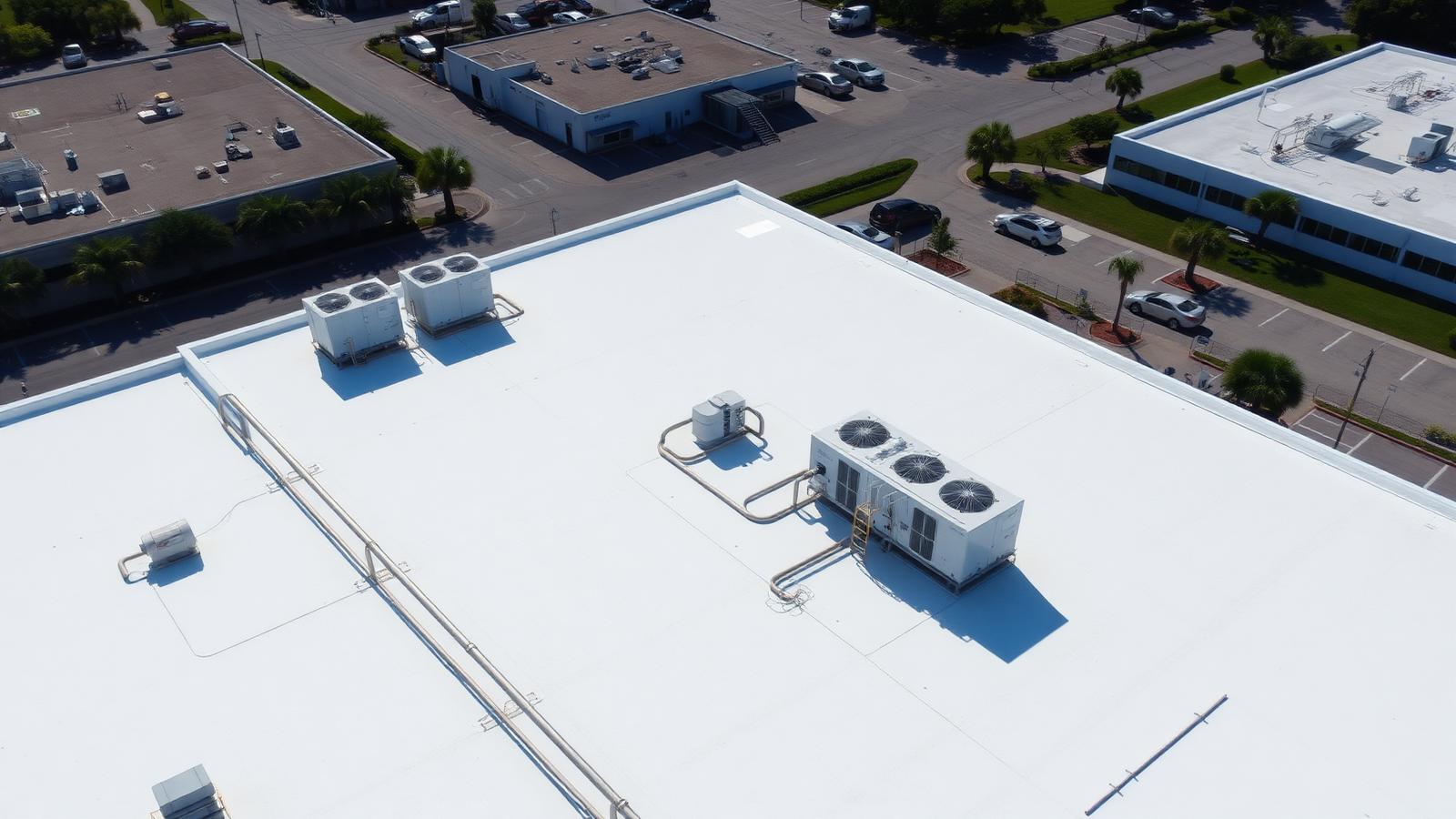
Now look at the other path. A roof restoration — cleaning, repairing, and coating your existing roof with a silicone or spray-applied system — doesn't tear anything off and doesn't install a new structural roof. Under the IRS tangible property regulations (the "repair regs"), work that keeps an existing building component in ordinary operating condition, without bettering it or replacing a major portion of it, is generally a deductible repair and maintenance expense in the year it's performed.
The regulations draw the capitalization line at things a coating project typically never touches: replacing load-bearing structural elements or decking supporting more than 40% of the roof, replacing more than 40% of the insulation layer, or materially upgrading the roof to a higher class of system. A restoration over a structurally sound roof — which is the only kind of roof we'll restore, more on that below — leaves the deck, the insulation, and the existing membrane in place. That's exactly the fact pattern the repair analysis favors.
To be straight with you, because that's how we've kept the same core crew for 20-plus years: this is not automatic. Facts matter. A coating applied to drag a failed, saturated roof back from the dead can look like a capitalizable "restoration" in the IRS's sense of the word. The condition of the roof before the work, what the scope actually includes, and how the project is documented all feed your CPA's analysis. This is precisely why the moisture survey and inspection report we produce on every project isn't just engineering paperwork — it's the documentation your accountant will ask for.
The IRS gives you 39 years to recover the cost of a new roof. A properly documented restoration may not make you wait past April.
The Worked Example: Same Roof, Two Tax Realities
Take an illustrative 60,000-square-foot flat roof, and use our standing rule of thumb that restoration runs about one-third the cost of replacement. Say replacement bids at $600,000 and restoration at $200,000. (Illustrative numbers — every roof prices on its own condition.)
Replacement, straight-line 39-year depreciation: roughly $15,400 of deduction per year. At a 21% corporate rate, that's about $3,200 of annual tax benefit against a $600,000 outlay. If your CPA can run it through Section 179, the picture improves dramatically — but only if your income, entity structure, and total 2026 purchases cooperate.
Restoration treated as a deductible repair: the full $200,000 lands on the 2026 return. At the same 21% rate, that's roughly $42,000 of tax benefit in year one. Combine that with the fact that you spent $400,000 less in cash, avoided tear-off, and never disrupted a tenant, and the total-cost gap between the two decisions is far wider than the bid sheets suggest.
One fairness note for the replacement column: if you do tear off an old roof, your CPA may be able to claim a partial disposition and write off the remaining basis of the old roof in the year of removal. It softens the blow. It doesn't close the gap.
When the Tax Answer Isn't the Roofing Answer
After 30-plus years and more than 10 million square feet of installed roofing across South Florida, we'll tell you what we tell every owner: the tax treatment never overrides the moisture survey. Our rule is simple. If less than 15% of the roof is wet, restoration is on the table. If more than 50% is saturated, you need a replacement, and we'll say so — no coating in the world fixes a drowned roof, and no deduction is worth installing one.
Timing matters too. Whichever path you take, 2026 benefits require the work to be done — placed in service — by December 31. South Florida's dry season, roughly November through April, is exactly when coating work runs fastest. Owners who get an assessment in October are the ones whose CPAs have options in December. And for those who were watching the 179D energy-efficiency deduction: under the 2025 tax law, that incentive terminated for projects beginning construction after June 30, 2026, so it's off the board for new starts — one more reason the repair-deduction analysis is now the main tax event in a restore-versus-replace decision.
FAQ
Can I really deduct a roof coating in the year I pay for it? Often, yes — when the coating keeps a structurally sound existing roof in operating condition rather than replacing major components or upgrading the system. It's a fact-specific call your CPA makes under the tangible property regulations, and it depends heavily on pre-project condition documentation like a moisture survey.
Does Section 179 cover a roof restoration too? Section 179 is aimed at capital improvements, including full roof replacements on nonresidential buildings. A restoration that qualifies as a deductible repair doesn't need Section 179 at all — the repair deduction is generally cleaner, isn't capped by the $2,560,000 limit, and isn't subject to the phase-out.
What documentation should I have before year-end? At minimum: a pre-project inspection report and moisture survey showing the roof's condition, a scope of work describing the project as maintenance of the existing system, and invoices that separate repair work from any capital items. We produce the first two on every ROOF KING project as standard practice.
Every roof decision starts with knowing what you actually have up there. ROOF KING has been restoring commercial roofs from our Pompano Beach headquarters for over 30 years — same core crew for more than 20 of them — and the first step costs nothing. Get your free roof assessment, including the moisture survey your CPA will want on file, before the year-end window closes. Call 954-782-3002 today.
This article is general information, not tax advice. Consult your CPA or tax advisor about your specific situation.
Sources
- https://www.thetaxadviser.com/newsletters/2017/jun/expensing-roofing-costs/
- https://www.section179.org/section_179_deduction/
- https://retrofitmagazine.com/unlock-the-value-of-section-179-for-owners-through-roof-replacements/
- https://www.therealestatecpa.com/blog/routine-maintenance-safe-harbor/
- https://www.law.cornell.edu/cfr/text/26/1.263(a)-3
Related reading
Free assessment
Free Commercial Roof Assessment
Licensed & insured Florida commercial roofing. Spray foam and silicone restoration across South Florida — no pressure, no cost.