The 2026 Tax Math on Roof Restoration: Section 179's $2.56M Limit, the 179D Sunset, and FPL Rates That Only Go Up
If your building's roof is on the capital plan for this year or next, the tax code just handed South Florida owners an unusually clear picture — and one door just closed. The Section 179 expensing limit climbed to $2,560,000 for 2026, the 179D energy-efficiency deduction sunset for projects starting after June 30, 2026, and FPL's newly approved rate settlement guarantees your electric bill trends one direction through 2029. Here's what that combination means for a commercial roof in Broward, Miami-Dade, or Palm Beach — with real numbers.
This article is general information, not tax advice. Run every figure here past your CPA before you act on it.
Section 179 in 2026: Roofs Are Deductible in Year One
Most owners still think of a roof as a 39-year depreciation slog — spend the money now, recover the deduction in slivers over four decades. Since the 2017 tax law, that's no longer the whole story: improvements to roofs on nonresidential real property qualify for Section 179 expensing, meaning the cost can be deducted in full in the year the work is placed in service.
The 2025 One Big Beautiful Bill Act supercharged the limits, and the 2026 inflation-adjusted numbers are the highest ever: you can expense up to $2,560,000 of qualifying property, with the phase-out not even starting until $4,090,000 in total purchases. For virtually every roof restoration in South Florida — and most full replacements — the entire job fits under the cap.
A worked example (illustrative numbers)
Say you manage a 60,000-square-foot flat-roof warehouse in Pompano Beach. The roof is aging but sound — a moisture scan shows well under 15% saturation, so under our Moisture Rule it's a restoration candidate, not a tear-off. Two paths:
- Replace: roughly 3x the cost of restoring. Call it $900,000 (illustrative — every roof prices differently). Tear-off, landfill fees, weeks of tenant disruption.
- Restore with SPF + silicone: roughly one-third of that — call it $300,000. No tear-off, no dumpsters, tenants stay open.
Both may qualify for Section 179. But here's the practical difference: Section 179 is limited by your business's taxable income, and a $300,000 deduction is far easier to absorb in one year than $900,000. At a 21% corporate rate, expensing that $300,000 restoration is worth roughly $63,000 back on the next return — real cash flow, in year one, instead of ~$7,700 a year dribbled out over 39 years. Your CPA may even determine that portions of a coating project qualify as a deductible repair rather than a capital improvement, which can be better still. That's a conversation worth having before the work starts, not after.
Restoration already costs about a third of replacement. Expensed under Section 179, next spring's tax return pays for a meaningful slice of the rest.
The 179D Window Just Closed — Unless You Broke Ground in Time
The Section 179D Energy Efficient Commercial Buildings deduction — worth $0.59 to $1.19 per square foot, and up to $5.94 with prevailing-wage compliance — was terminated by the OBBBA for any project where construction begins after June 30, 2026. That date has passed.
Two things South Florida owners should know. First, if your energy-efficiency project broke ground on or before June 30, 2026, it remains fully eligible under the old rules even if it's completed and placed in service in 2027 or later — don't leave that money on the table; document your construction start date. Second, for everyone else, Section 179 is now the workhorse. The good news: unlike 179D, it doesn't require energy modeling or certification — a qualifying roof improvement on a nonresidential building simply qualifies.
FPL's $6.9 Billion Settlement: The Other Half of the ROI
In November 2025, Florida regulators approved FPL's four-year rate settlement — roughly $6.9 billion in increases running 2026 through 2029. Bills stepped up in January 2026, step up again in 2027, and additional solar and battery cost recovery continues after that. Whatever a kilowatt-hour costs your building today, it will cost more every year of this settlement.
That changes the math on the roof itself. A dark, aged roof membrane in our climate absorbs heat all day and feeds it into your conditioned space. A high-reflectivity white silicone coating does the opposite: EPA data shows reflective "cool" roofs can cut peak cooling demand by 11–27%, and in un-air-conditioned spaces like warehouses, drop indoor temperatures by up to 5.9°F. On a South Florida building that runs air conditioning eleven months a year, against rates that are locked into annual increases, reflectivity is no longer a nice-to-have — it's a hedge.
Stack it up: one-third the cost of replacement, expensed in year one under Section 179, then shaving cooling load every month against rising FPL rates. That's three separate returns from one project.
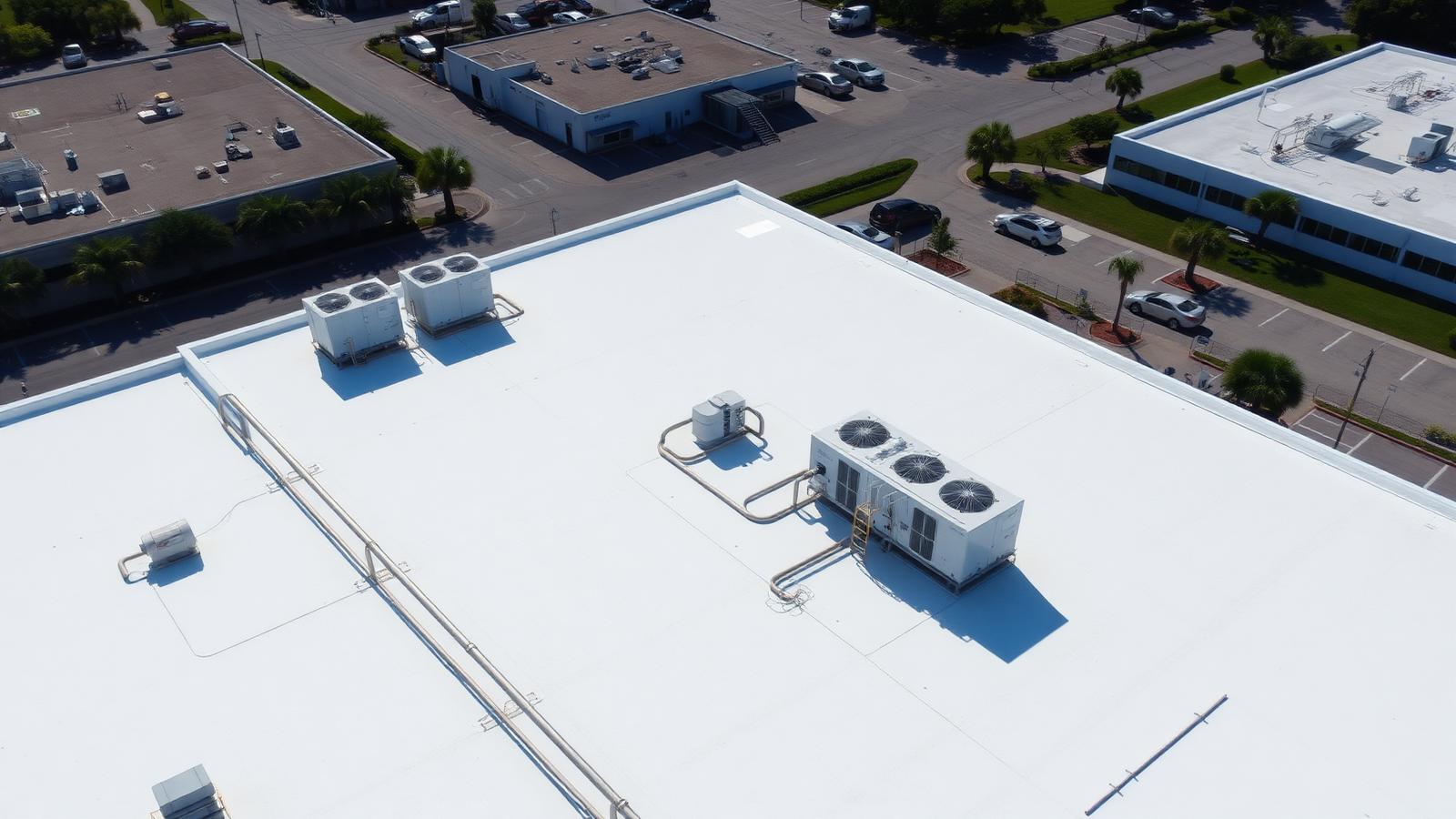
What This Looks Like on a Real Building
We've installed over 10 million square feet of SPF and silicone roofing across South Florida in 30+ years — same core crew for more than 20 of those years, 25 people on payroll, seven fully rigged spray trucks out of our Pompano Beach headquarters. The pattern we see on tax-driven projects is consistent: the owners who win are the ones who get the roof assessed early in the tax year, so the moisture scan, the scope, and the CPA conversation all happen before Q4 — and the project is placed in service before December 31, when it counts.
And we'll tell you the truth about which side of the line you're on. Under 15% moisture saturation, restoration is the smart play. Over 50%, coating a wet roof is throwing money away — you need replacement, and we'll say so. That honesty is why other roofing contractors sub their spray-foam and coating work to us.
FAQ
Does a silicone roof coating qualify for Section 179? Roof improvements to nonresidential real property are Section 179-eligible, and restoration projects are generally treated as qualifying improvements. Depending on scope, your CPA may alternatively classify some coating work as a currently deductible repair. Either way, the cost is typically recoverable far faster than 39-year depreciation — get your CPA's read on your specific project.
Is it too late to claim 179D? For new projects, yes — the deduction ended for construction beginning after June 30, 2026. But if your project broke ground on or before that date, you're still eligible under the prior rules, even if completion runs into 2027. Verify and document your start date.
When does the work have to be finished to count for 2026? Section 179 applies in the tax year the improvement is placed in service — for a roof, when the work is complete and the roof is doing its job. A restoration started in October can realistically make the deadline; one started in mid-December usually can't. Book the assessment early.
The tax code is rewarding owners who restore instead of replace, and FPL is penalizing everyone who waits. Find out which side of the Moisture Rule your roof is on: schedule a free roof assessment with ROOF KING, or try our Instant Roof Analyzer online. Call 954-782-3002 — Strength from above.
Sources
- https://www.blockadvisors.com/resource-center/small-business-tax-prep/section-179-expensing/
- https://engineeredtaxservices.com/179d-tax-credit-update-the-deadline-has-passed/
- https://floridaphoenix.com/2025/11/20/psc-approves-contentious-7-billion-rate-hike-for-florida-power-light-customers/
- https://newsroom.fpl.com/2025-11-20-Florida-regulators-approve-FPL-rate-agreement-that-keeps-customer-bills-low,-meets-needs-of-growing-state
- https://www.epa.gov/heatislands/using-cool-roofs-reduce-heat-islands
Related reading
Free assessment
Free Commercial Roof Assessment
Licensed & insured Florida commercial roofing. Spray foam and silicone restoration across South Florida — no pressure, no cost.